How Do You Say Green In Chinese

Table of Contents [hide]
It Started With a Traffic Light
Lena, a graphic designer from Portland with over seven years of professional experience in UI/UX and branding, found herself standing motionless at a bustling intersection in Beijing’s Chaoyang District—surrounded by honking electric scooters, billowing bicycle traffic, and towering glass skyscrapers adorned with neon signage. She’d spent six months preparing for her semester-long residency at the Central Academy of Fine Arts: memorizing HSK 1–2 vocabulary, drilling tones with Anki flashcards, and even practicing daily dialogues with a language partner via HelloTalk. She confidently recognized the red light (红灯 hóng dēng) as an unmistakable universal signal—and she knew yellow (黄灯 huáng dēng) meant caution—but when the third light illuminated—a vivid, luminous emerald glow—the neural pathways in her brain momentarily short-circuited. Her mouth opened, then closed. The word vanished—not just from memory, but from immediate linguistic retrieval. She’d studied colors thoroughly: red, blue, yellow, black, white—but ‘green’ had slipped away like mist at dawn. That disorienting pause, lasting barely three seconds yet feeling like an eternity, became a catalyst. It wasn’t merely about recalling a single syllable; it was about understanding how 绿 (lǜ) functions as a phonemic anchor, a tonal landmark, a visual glyph embedded in thousands of compound words, idioms, and cultural metaphors—from environmental policy documents to tea ceremony menus to subway signage. This article goes far beyond translation. It explores green not as an isolated lexical item, but as a living, breathing element of Mandarin communication: its acoustic signature, its orthographic logic, its grammatical behavior, its regional consistency, its semantic boundaries—and why mastering it unlocks fluency far beyond color naming. If you’ve ever confused 绿 (lǜ) with 路 (lù), misread the tone mark as a simple ‘u’, or hesitated before ordering matcha-flavored buns at a Beijing bakery because you weren’t sure whether to say 绿色 or 青色, you’re in excellent company—and this guide is built precisely for that moment of uncertainty.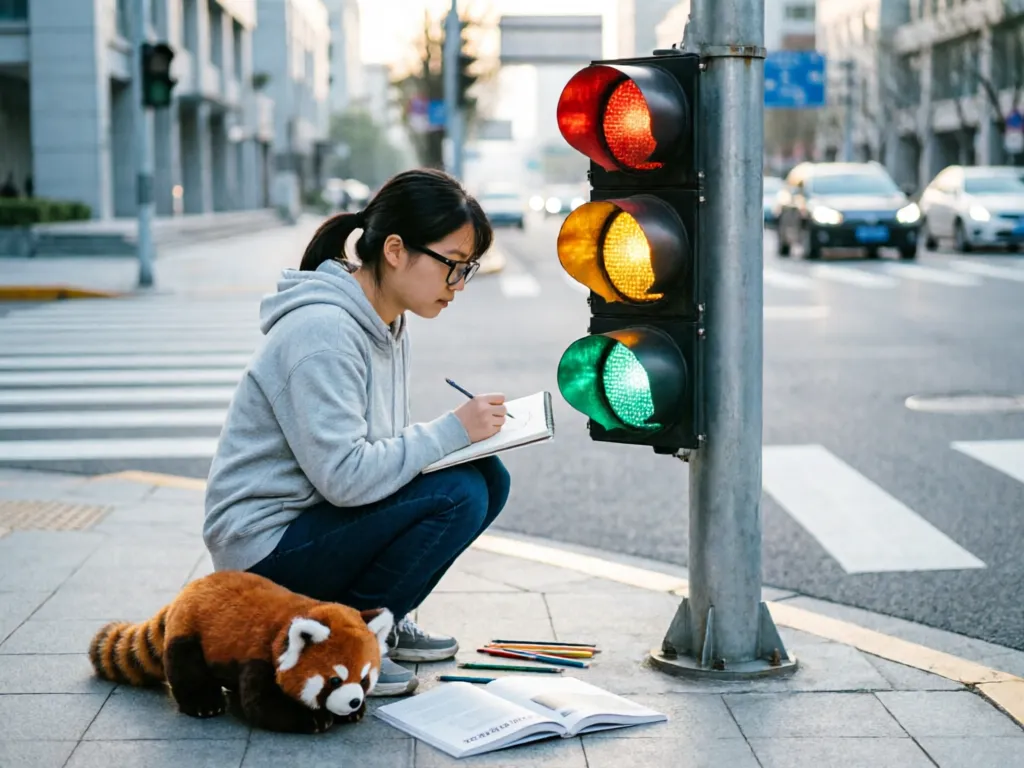 Learn more: Study Chinese in China.
1. The Word: 绿 (lǜ) — and Why the Tone Matters
The standard, universally accepted Mandarin word for the color green is the single-character adjective 绿, pronounced lǜ—with a precise fourth tone (falling-rising contour: 51→35, starting high and sharply descending before rising slightly, like the intonation of an English speaker asking 'Really?' with genuine surprise and curiosity). This tone is non-negotiable: changing it alters meaning entirely and can lead to serious misunderstandings. For instance, lù (with tone 4 but without the umlaut—i.e., written as 路) means 'road' or 'path'; lú (tone 2, no umlaut) means 'stove' or 'furnace'; lǔ (tone 3) is unrelated and means 'to coerce' or 'to force'; while lū (tone 1) doesn’t exist as a standalone color term. Only lǜ—with both the correct tone *and* the umlauted ü (representing the front-rounded vowel /y/, similar to French 'tu' or German 'über')—carries the unambiguous meaning of 'green'. The ü is not optional typography—it’s phonemic. Omitting it renders pronunciation incomprehensible to native speakers. To train your ear and vocal muscles simultaneously, begin with minimal pair drills: record yourself saying lǜ, lù, lú, and lǔ back-to-back, then compare each against native audio on rplschool.com’s scientifically validated tone practice page, which features slow-motion waveform visualization and pitch-tracking feedback. Supplement auditory training with kinesthetic reinforcement: write the character 绿 five times slowly while vocalizing lǜ aloud—paying attention to tongue position (high and front, lips rounded), jaw relaxation, and breath control. Research in second-language acquisition confirms that multimodal encoding—combining visual (writing), auditory (listening/speaking), and motor (handwriting) input—increases retention by up to 270% compared to passive listening alone. Bonus tip: use tone-color association—imagine the fourth tone as a downward arrow followed by an upward spring, mirroring the vibrant bounce of fresh spinach leaves under sunlight.
2. Building Fluency: From Single Word to Real Phrases
Knowing the isolated word 绿 (lǜ) is only the foundational brick; true communicative fluency emerges when you deploy it naturally across authentic, high-frequency contexts. In spoken Mandarin, you almost never utter 'green' in isolation—just as English speakers rarely say 'red!' without specifying 'red car', 'red wine', or 'red flag'. Instead, green operates as a modifier within tightly knit noun phrases, where it consistently precedes the head noun and often appears with the attributive particle 的 (de) when describing possession or quality. Start with concrete, tangible referents: green tea (绿茶 lǜ chá)—China’s most iconic beverage, consumed daily by over 400 million people; green light (绿灯 lǜ dēng)—not only the literal traffic signal but also a widely understood idiom meaning 'official approval' or 'go-ahead' (e.g., 政府为项目开了绿灯—The government gave the project the green light); green leaf (绿叶 lǜ yè)—a botanical term used in agriculture, cooking, and traditional medicine; green space (绿地 lǜ dì)—a key urban planning term referring to parks, gardens, and ecological corridors in cities like Shenzhen and Hangzhou. Crucially, avoid oversimplifying the color spectrum: while 绿 denotes pure, chromatic green, the character 青 (qīng) occupies a broader perceptual band—encompassing bluish-greens (青草 qīng cǎo = green grass), teal-like hues (青花瓷 qīng huā cí = blue-and-white porcelain), and even metaphorical meanings like youthfulness (青年 qīng nián = young person) or clarity (青天 qīng tiān = clear blue sky). Context—not dictionary definitions—determines whether to choose 绿 or 青. To internalize usage patterns, master these twelve essential, real-world phrases—each drawn from HSK-aligned textbooks, official government publications, and everyday signage: 绿色 (lǜ sè) — green color (the nominal form, used in formal contexts); 绿茶 (lǜ chá) — green tea (most common beverage example); 绿灯 (lǜ dēng) — green light (traffic + idiom); 绿叶 (lǜ yè) — green leaf (botanical & culinary); 绿地 (lǜ dì) — green space (urban planning); 绿色环保 (lǜ sè huán bǎo) — eco-friendly / green environmental protection (policy & sustainability); 绿衣服 (lǜ yī fu) — green clothes (everyday apparel); 绿色蔬菜 (lǜ sè shū cài) — green vegetables (supermarket & dietary context); 绿色能源 (lǜ sè néng yuán) — green energy (renewables, solar/wind); 绿色出行 (lǜ sè chū xíng) — green transportation (biking, e-buses, metro); 绿色建筑 (lǜ sè jiàn zhù) — green building (LEED-certified structures); 绿色发展 (lǜ sè fā zhǎn) — green development (national economic strategy). Say each phrase aloud five times, exaggerating the tone on lǜ, then use them in original sentences: 'My office installed green lighting to support sustainable development.' → 我们的办公室安装了绿色照明,支持绿色发展。
3. Reading & Writing: One Character, Two Forms, Zero Excuses
The character 绿 exists in two standardized orthographic forms—simplified Chinese (used officially in mainland China, Singapore, and Malaysia) and traditional Chinese (used in Taiwan, Hong Kong, and Macau)—but both share identical pronunciation (lǜ), core meaning ('green'), and grammatical function. The simplified form is 绿 (12 strokes), while the traditional variant is 綠 (16 strokes), differing only in the left-side radical: simplified uses 纟 (a shorthand for 糸, meaning 'silk'), whereas traditional retains the full 糸 component. This historical connection is deeply meaningful: ancient Chinese dyers used plant-based pigments—including indigo and wild spinach—to produce verdant hues on silk textiles, making the 'silk' radical a semantic nod to material culture and craftsmanship. The right side, 录 (lù), serves a dual role—as both a phonetic indicator (its pronunciation approximates the tone and vowel of lǜ) and a mnemonic anchor (think: 'record' the tone, 'record' the shape). When writing 绿, follow the prescribed stroke order meticulously: start at the top-left dot, proceed clockwise through the silk radical, then complete the 录 portion with its characteristic hook and horizontal stroke. Trace it slowly ten times using grid paper, verbalizing each stroke name ('dot', 'horizontal', 'vertical', etc.) to strengthen neural mapping. Then cover your notes and rewrite it from memory—this active recall method boosts long-term retention more effectively than rote copying. Next, embed the character into high-utility, low-complexity sentences that reflect real-life interactions: 这是绿色。 (Zhè shì lǜ sè.) — This is green. (Used in classrooms, design briefings, paint stores.) 我喜欢绿色。 (Wǒ xǐ huān lǜ sè.) — I like green. (Common in surveys, personality assessments, fashion consultations.) 你的包是绿色的吗? (Nǐ de bāo shì lǜ sè de ma?) — Is your bag green? (Practical for lost-and-found, travel, retail.) 这件衬衫是绿色的。 (Zhè jiàn chèn shān shì lǜ sè de.) — This shirt is green. (Clothing shopping, online returns.) 绿色很适合你。 (Lǜ sè hěn shì hé nǐ.) — Green suits you very well. (Compliments, styling advice.) These sentences deliberately omit complex grammar (no aspect particles, no serial verbs, no measure words beyond 件) so learners build confidence through repetition, rhythm, and contextual relevance—not abstract rules.
4. Beyond Basic: How Colors Function Grammatically
In Mandarin grammar, color words like 绿 behave with remarkable consistency—unlike English, where adjectives require copular verbs ('is', 'are') and inflect minimally, Mandarin color terms operate as stative verbs or attributive nouns depending on syntactic position. When modifying a noun directly, they typically appear in the compound form 绿色 (lǜ sè) followed by the particle 的 (de): 绿色的车 (lǜ sè de chē) = green car; 绿色的苹果 (lǜ sè de píng guǒ) = green apple. Note that 绿 alone (without 色) is rarely used attributively in modern standard speech—though it appears in fixed compounds like 绿灯 and 绿茶. When stating identity or classification ('This is green'), the copula 是 (shì) is required: 这是绿色。 (Zhè shì lǜ sè.) — This is green. (Not *这是绿.) When expressing preference or emotion, no copula is needed: 我喜欢绿色。 (Wǒ xǐ huān lǜ sè.) — I like green. (Not *我喜欢绿.) Importantly, 绿色 is semantically neutral and concrete—it denotes hue, not inherent value—unless modified by context: 绿色经济 (lǜ sè jīng jì) = green economy (eco-conscious); 绿色金融 (lǜ sè jīn róng) = green finance (ESG investing); 绿色壁垒 (lǜ sè bì lěi) = green barrier (environmental trade restrictions). For HSK 1–2 learners, prioritize tangible, sensorially grounded applications: identifying traffic signals (red/yellow/green), describing food (green peppers, matcha desserts), naming clothing items (green scarf, olive jacket), and discussing nature (green mountains, green moss). Statistically, 绿 ranks among the top 12 color terms tested on HSK exams—appearing in listening comprehension (e.g., 'Which light turns on next?'), reading passages (e.g., 'The park has large green spaces'), and speaking prompts (e.g., 'Describe your favorite color'). Pro tip: group colors by tone to train your ear holistically: lǜ (4), hóng (2), huáng (2), lán (2), zǐ (3), bái (2), hēi (1), fěn (3), zōng (1), yín (2)—creating mental pitch 'families' that accelerate pattern recognition and reduce tone fatigue.
Color Chart: Green & Related Terms
| Chinese | Pinyin | English Meaning / Usage |
|---|---|---|
| 绿 | lǜ | core adjective: green (tone 4); used in compounds and idioms, rarely standalone |
| 绿色 | lǜ sè | green color; nominal form, used attributively (e.g., 绿色帽子, 绿色政策) |
| 绿灯 | lǜ dēng | green light; literal traffic signal + figurative 'approval' or 'permission' |
| 绿茶 | lǜ chá | green tea — unfermented Camellia sinensis, culturally central beverage |
| 青 | qīng | blue-green; broad perceptual range—sky (青天), grass (青草), youth (青年), jade (青玉) |
| 翠绿 | cuì lǜ | emerald green — vivid, saturated, poetic shade; used in literature and art criticism |
| 墨绿 | mò lǜ | dark green / forest green — ink-inspired depth; common in fashion and interior design |
| 橄榄绿 | gǎn lǎn lǜ | olive green — military, earthy, naturalistic tone; used in uniforms and sustainability branding |