Chinese Dialects

Table of Contents [hide]
- Key Takeaways
- What Are Chinese Dialects — Really?
- The Big Eight: Major Chinese Language Varieties
- Mandarin vs Cantonese: Beyond the Surface
- Why Mutual Intelligibility Matters More Than Labels
- Regional Dialects in China: From Village to Metropolis
- Living Language: Slang, Memes, and Modern Identity
- Preservation vs. Policy: Education, Media, and Endangerment
- Beyond China: Global Communities and Digital Revival
- Key Features Across Major Chinese Language Varieties
- FAQ
- References
Key Takeaways
- Chinese 'dialects' like Cantonese, Wu, and Hakka are linguistically distinct languages—not dialects—due to mutual unintelligibility, divergent tones, grammar, and vocabulary, and are properly classified as separate Sinitic languages within the Sino-Tibetan family.
- The term 'Chinese dialects' is a politically motivated misnomer promoted since the early 20th century to reinforce national unity under Putonghua, obscuring real linguistic diversity and marginalizing non-Mandarin speakers.
- The 'Big Eight' language varieties—Mandarin, Wu, Yue (Cantonese), Min, Hakka, Gan, Xiang, and Jin—each have deep historical roots, unique phonological systems (e.g., Cantonese’s 6–9 tones), literary traditions, and millions of native speakers across Greater China and diaspora communities.
- Non-Mandarin varieties face sociolinguistic pressures including workplace discrimination, educational barriers, and declining intergenerational transmission—leading UNESCO to classify several (e.g., Cantonese, Wu) as endangered.
- Academic and advocacy shifts toward using 'Chinese language varieties' instead of 'dialects' reflect empirical accuracy and respect for linguistic identity; recognizing them as distinct languages supports preservation without implying separatism.
What Are Chinese Dialects — Really?
The term 'Chinese dialects' is profoundly misleading—and intentionally so. Linguistically, what are commonly called 'Chinese dialects'—such as Cantonese, Shanghainese, Hokkien, or Hakka—are not dialects of a single language in the technical sense. They are mutually unintelligible language varieties, often as distinct from one another as Spanish is from Italian or German from Dutch. Mandarin vs Cantonese, for instance, share only about 30% lexical similarity and differ radically in tone systems (Mandarin has four tones; Cantonese has six to nine), syntax, and grammar—making spoken communication impossible without prior study. This is why linguists classify them as separate languages within the Sinitic branch of the Sino-Tibetan family—not 'dialects' of Chinese. The misnomer persists largely due to political unification: since the early 20th century, the Chinese state has promoted Putonghua (Standard Mandarin) as the sole national language, framing regional speech forms as 'regional dialects in China' to reinforce cultural and administrative cohesion. In education, media, and official documents, terms like 'Chinese dialects' uphold the fiction of linguistic unity—even as speakers of different Chinese dialects cannot understand each other. A Chinese dialect map reveals this stark reality: the Yangtze River roughly divides northern Mandarin-speaking areas from southern zones where Wu, Gan, Xiang, Min, Yue (Cantonese), and Hakka dominate—each with centuries-old literary traditions, dictionaries, and grammars. Even today, a Cantonese speaker from Guangzhou and a Minnan speaker from Quanzhou may resort to written Standard Chinese (which uses shared characters but divergent pronunciation and grammar) or English to converse. The sociolinguistic consequences are tangible: speakers of non-Mandarin varieties often face workplace discrimination, educational barriers, and erasure of linguistic identity—what some call '背锅' (bēi guō, 'taking the blame') for 'failing' to conform, while Mandarin speakers enjoy automatic privilege. Meanwhile, internet culture subtly resists homogenization: phrases like 摸鱼 (mō yú, 'goofing off') circulate widely across varieties—but their pronunciation, tone, and even meaning shift dramatically across regions, revealing linguistic fault lines no policy can smooth over. Academically, scholars increasingly use 'Chinese language varieties' instead of 'Chinese dialects' to reflect empirical reality. UNESCO lists several—including Cantonese and Wu—as endangered, citing declining intergenerational transmission. Recognizing these varieties as distinct languages isn’t separatist—it’s accurate, respectful, and essential for preservation. To call them 'dialects' isn’t neutral description; it’s linguistic cartography shaped by power.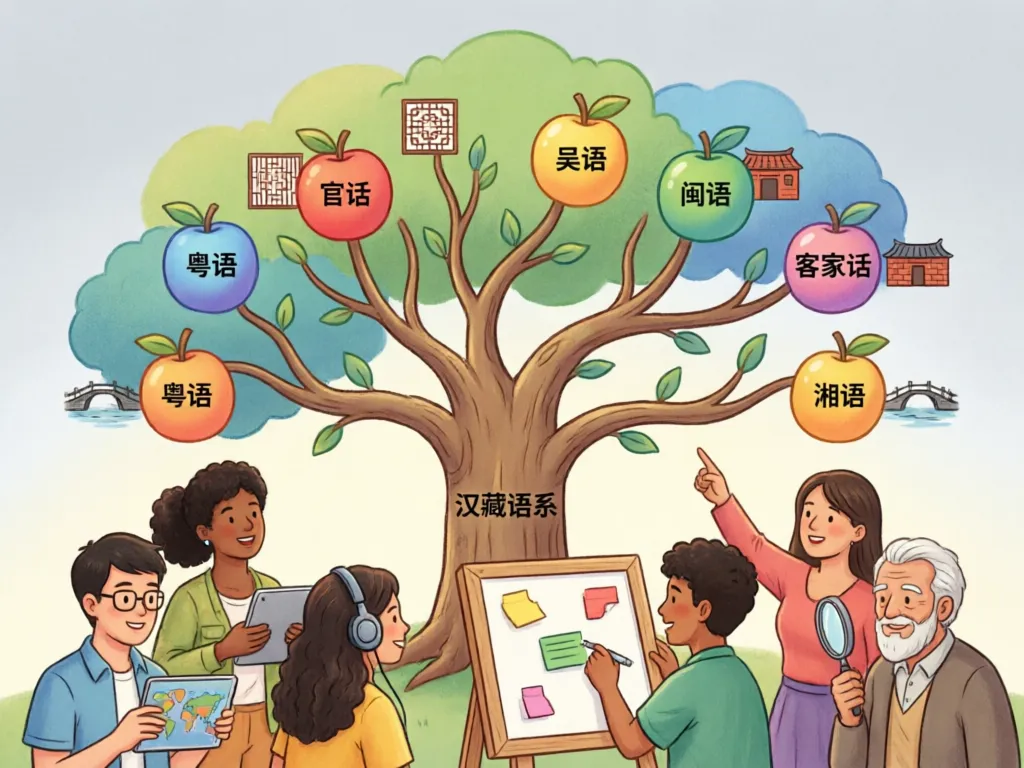
The Big Eight: Major Chinese Language Varieties
The eight major Chinese language varieties—often called the 'Big Eight'—form the traditional framework for understanding linguistic diversity across Greater China. These are not mere accents or 'dialects' in the colloquial sense but distinct, mutually unintelligible Sinitic languages with deep historical roots, complex tonal systems, and divergent grammars and vocabularies. Mandarin, the official language of China and Taiwan and one of Singapore’s four national languages, dominates demographically: over 900 million native speakers inhabit northern, southwestern, and central China, including Beijing, Chengdu, and Kunming. Wu, spoken by roughly 80–90 million people in Shanghai, Zhejiang, and southern Jiangsu, features soft consonants and up to eight tones; its Shanghainese variety famously uses the slang term 摸鱼 (‘to shirk work’), reflecting local pragmatism. Yue (Cantonese), with ~60–80 million speakers in Guangdong, Guangxi, Hong Kong, and Macau, remains a cultural and media powerhouse—its robust presence fuels frequent comparisons in Mandarin vs Cantonese debates, especially around education policy and identity. Min, the most internally diverse group, splits into Southern Min (e.g., Hokkien, Teochew, Taiwanese), Eastern Min (Fuzhou), and others, spanning Fujian, Taiwan, Hainan, and overseas communities; speaker estimates exceed 70 million. Hakka, spoken by ~45 million people across scattered enclaves in Guangdong, Jiangxi, Fujian, Taiwan, and Southeast Asia, preserves archaic vocabulary and is often associated with resilience—its speakers historically ‘背锅’ (‘took the blame’) during dynastic upheavals. Gan, concentrated in Jiangxi and parts of Hunan and Hubei, has ~20–30 million speakers and retains Middle Chinese voiced initials. Xiang, centered on Hunan (especially Changsha), numbers ~37 million and shows strong influence from both Mandarin and Gan. Jin, sometimes classified as a Mandarin subgroup but recognized separately for its preserved checked tone and unique grammatical particles, covers Shanxi, Inner Mongolia’s Hohhot region, and parts of Shaanxi and Hebei, with ~45–50 million speakers. Collectively, these eight Chinese language varieties reflect millennia of migration, topography, and administrative history—not just regional dialects in China, but living systems shaped by rivers, mountains, and empire. A Chinese dialect map reveals how geography constrains diffusion: the Yangtze River separates Wu and Xiang; the Nanling Mountains isolate Yue and Hakka; Fujian’s rugged coast fostered Min’s fragmentation. While Mandarin’s institutional dominance grows, vitality varies: Cantonese thrives in pop culture and legal settings; Wu faces steep intergenerational decline in urban centers; Jin retains strong rural usage. Understanding these different Chinese dialects demands moving beyond the Mandarin-centric lens—recognizing that 摸鱼 might mean ‘slacking off’ in Shanghai but carries no equivalent in Hakka, and that 背锅 implies social accountability in Hakka discourse but functions differently in Xiang.Mandarin vs Cantonese: Beyond the Surface
Mandarin and Cantonese are not merely ‘accents’ of a single Chinese language—they are distinct Chinese language varieties with deep historical, phonological, and sociolinguistic divergence. Linguistically, they are mutually unintelligible: a Mandarin speaker cannot understand spoken Cantonese without study, and vice versa—akin to the relationship between Spanish and Italian. Pronunciation differs radically: Mandarin has four main tones (plus a neutral tone), while Cantonese preserves six to nine tones depending on analysis, with complex contour distinctions (e.g., high-level vs. high-falling) that shape meaning entirely. Vocabulary diverges significantly—‘to eat’ is chī in Mandarin but sik6 in Cantonese; ‘what’ is shénme versus māah6. Even everyday slang reflects this split: the internet term 摸鱼 (‘to slack off’, literally ‘touch fish’) is widely used in Mandarin-speaking online spaces, while Cantonese speakers might say 鬼混 (gwai2 wan6) or use English loanwords like ‘chill’. Similarly, 背锅 (‘to take the blame’, lit. ‘carry the pot’) circulates across Mandarin-dominant platforms but lacks direct, idiomatic equivalents in colloquial Cantonese, where expressions like 代人受過 (doi6 jan4 sau6 gwo3) are more formal and less viral. Writing systems reveal another layer: both use Chinese characters, but Cantonese employs many unique characters—like 咗 (zo2, past-tense marker) or 佢 (keoi5, ‘he/she’)—absent in standard Mandarin orthography. In formal writing, however, Cantonese speakers often adopt Mandarin-based grammar and lexicon, creating a diglossic situation. Sociolinguistically, Mandarin is China’s sole official language, promoted nationwide through education and media, whereas Cantonese holds co-official status only in Hong Kong and Macau—and even there, its use in government and higher education is increasingly constrained. This asymmetry shapes perceptions: Mandarin is often mislabeled the ‘standard Chinese dialect’, reinforcing the misconception that other Chinese dialects are subordinate variants. In reality, Mandarin vs Cantonese exemplifies how regional dialects in China reflect millennia of geographic isolation, migration, and political consolidation. The Chinese dialect map shows Mandarin dominating northern and southwestern China, while Cantonese anchors the Pearl River Delta—a linguistic boundary reinforced by rivers, mountains, and history. Recognizing these differences is essential for accurate linguistic classification: Mandarin and Cantonese are not dialects of each other but sister branches of Sinitic, each with full internal complexity. Treating them as interchangeable undermines language rights, educational equity, and cultural preservation—especially as younger generations in Guangdong and Hong Kong shift toward Mandarin dominance. Understanding Mandarin vs Cantonese thus means acknowledging not just phonetic contrasts, but the lived realities encoded in different Chinese dialects: from classroom policy to meme culture, from street signage to family dinner talk.Why Mutual Intelligibility Matters More Than Labels
Mutual intelligibility—the ability of speakers to understand each other without prior exposure or study—is the linguistic litmus test that reveals why calling Mandarin, Cantonese, Wu, Min, Hakka, and Gan mere 'Chinese dialects' is profoundly misleading. While politically convenient and historically rooted in shared writing systems and cultural identity, the label 'dialect' obscures a stark reality: a speaker from Beijing cannot comprehend a speaker from Guangzhou any more than a Spaniard understands a Portuguese speaker—or, for that matter, a German speaker understands Dutch. Mandarin vs Cantonese illustrates this most vividly: their phonological systems diverge radically (Cantonese has six to nine tones; Mandarin has four), vocabulary differs substantially (e.g., 'to eat' is chī in Mandarin but sik6 in Cantonese), and grammar exhibits key distinctions—such as aspect markers and sentence-final particles like 咗 (zo2) or 啦 (laa1), which have no direct Mandarin equivalents. Even common idioms resist translation: the playful internet phrase 摸鱼 ('mō yú', 'to fish for fun'—i.e., slacking off at work) carries nuanced workplace irony in Mandarin, but its Cantonese counterpart (e.g., 攬滑 (laam4 waat3)) evokes entirely different imagery and register. Similarly, 背锅 ('bēi guō', 'to carry the pot')—meaning to take the blame for others—is widely understood across Mandarin-speaking regions, yet lacks a direct, culturally resonant equivalent in many regional dialects in China, where blame attribution follows distinct pragmatic conventions. This breakdown isn’t marginal—it’s systemic. On a Chinese dialect map, adjacent varieties like Southern Min (e.g., Hokkien) and Eastern Min (e.g., Fuzhounese) may share only 30–40% lexical similarity; Shanghainese (Wu) and Xiamen Hokkien (Min Nan) are mutually unintelligible despite geographic proximity. These aren’t accents or registers—they’re separate Chinese language varieties with independent sound changes, grammatical innovations, and literary traditions. For daily communication, this means a doctor in Chengdu (Sichuanese Mandarin) may struggle to diagnose an elderly patient from Taishan (Yue) unless they switch to written characters—or better yet, use Mandarin as a lingua franca. A teacher in rural Fujian might need interpreters to explain school policy to parents speaking local Min varieties. And while standardized Mandarin unifies administration and education, over 30% of China’s population still uses non-Mandarin Chinese language varieties at home—many of whom report frustration when official forms, healthcare instructions, or emergency alerts assume Mandarin fluency. Recognizing these as distinct languages—not 'dialects'—isn’t semantic nitpicking. It validates lived experience, informs inclusive policy (e.g., multilingual public signage in Guangdong or Fujian), and guides effective language preservation. When mutual intelligibility fails, labels must follow reality—not politics. Learn more: Flexible Chinese Classes | Flexi Classes - Group Chinese Classes in Beihai.Regional Dialects in China: From Village to Metropolis
Regional dialects in China defy simple provincial boundaries—variation emerges not just between Guangdong and Sichuan, but across subway lines in Guangzhou, between apartment blocks in Chengdu, and even within single villages in Fujian’s mountainous Wuyi region. A farmer in rural Nan’an may speak a Hokkien variant so distinct from urban Xiamen’s that mutual intelligibility drops below 40%, while Shanghainese speakers in Pudong’s high-rises increasingly default to a hybrid ‘Shanghainese-Mandarin koine’—blending local phonology with Putonghua syntax and loanwords like 摸鱼 (‘slacking off’, now used by Gen Z across dialect zones) or 背锅 (‘taking the blame’, widely adopted in workplace banter regardless of native tongue). This micro-variation is visible on the Chinese dialect map: over 10 major groups—Mandarin, Wu, Yue (Cantonese), Min, Hakka, Gan, Xiang, Jin, Huizhou, Pinghua—contain more than 200 documented sub-varieties, many unrecorded in official surveys. In Guangzhou, for example, older residents in Liwan District preserve classical Cantonese tones and vocabulary absent in newer Baiyun District speech, where Mandarin-influenced intonation and code-switched terms dominate. Similarly, Chaozhou’s Teochew speakers use distinct vowel shifts and lexical items (e.g., ‘to eat’ as *jiaq* rather than Cantonese *sik* or Mandarin *chī*) that distinguish them from nearby Shantou—even though both fall under Southern Min. Urbanization accelerates divergence: Beijing’s migrant-heavy Haidian District hosts a ‘Beijing Mandarin’ laced with Hebei and Henan substrate features, while Chengdu’s Tianfu New Area youth blend Sichuanese rising tones with English loanwords and internet slang, rendering their speech nearly unintelligible to elders in nearby Pengzhou villages. Crucially, Mandarin vs Cantonese reflects not just geography but sociolinguistic hierarchy: Cantonese retains robust media presence and legal status in Hong Kong, whereas many Wu dialects—like Suzhounese—face near-total displacement in schools and public services. Generational shifts are stark: in Ningbo, only 12% of children aged 6–12 can produce full Wu verb aspect markers, per 2023 Zhejiang University fieldwork; most default to Mandarin grammar with Wu vocabulary—creating unstable hybrid forms. Yet resistance persists: Shanghai’s ‘Wu Language Revival’ workshops teach teens to write 摸鱼 in traditional Wu orthography, and Guangzhou middle schools now offer elective Cantonese poetry classes. These efforts acknowledge a core truth: Chinese dialects aren’t fading relics—they’re dynamic, contested systems adapting at village wells, metro platforms, and WeChat group chats.Living Language: Slang, Memes, and Modern Identity
Chinese dialects are no longer confined to family dinners or local markets—they’re thriving in digital spaces, where slang and memes forge new layers of cultural identity. Take 摸鱼 (mō yú), literally ‘to fish idly,’ which originated in Mandarin as workplace jargon for slacking off but has since exploded across platforms like Weibo and Xiaohongshu. Its playful absurdity—imagining someone quietly fishing while supposed to be working—resonates so widely that it’s now used by speakers of different Chinese dialects, even when translated phonetically into Cantonese (mou4 jyu4) or Shanghainese (moq nyu). Similarly, the Cantonese expression 背锅 (bui3 gwo1, ‘to carry the pot’)—meaning to take unjust blame—has migrated far beyond Guangdong and Hong Kong. In mainland corporate WeChat groups, it appears alongside Mandarin equivalents like 背黑锅 (bēi hēi guō), demonstrating how regional dialects inject moral nuance into shared digital experiences. This cross-dialect adoption isn’t random: it reflects strategic linguistic borrowing rooted in perceived authenticity and emotional precision. While Mandarin dominates official communication, users choose dialect-based terms like 背锅 over standard Mandarin alternatives precisely because they carry sharper sociocultural connotations—irony, resignation, or communal solidarity—that generic Mandarin phrases often lack. A glance at the Chinese dialect map reveals why this matters: with over 10 major Chinese language varieties—including Wu, Min, Hakka, and Gan—each carrying distinct grammatical structures and lexical inventories, the internet becomes a rare neutral ground where regional dialects negotiate visibility on equal footing. Young netizens from Chengdu, Xiamen, or Shenyang might all deploy 摸鱼 in a meme caption, but add a Sichuanese particle like ‘哈’ (ha) or a Hokkien loanword like ‘拍谢’ (pāi xiè, ‘sorry’) to subtly signal their roots. Such hybrid usage challenges outdated hierarchies that position Mandarin as ‘standard’ and other regional dialects in China as ‘variants’ or ‘accents.’ Instead, online spaces treat Chinese dialects as living resources—flexible, adaptable, and deeply expressive. Linguists note that over 60% of top-100 trending WeChat stickers in 2023 incorporated at least one non-Mandarin lexical item, most commonly from Cantonese or Northeastern Mandarin. Crucially, this isn’t assimilation—it’s code-switching with intent. When a Beijing student types 背锅 in a group chat with friends from Guangzhou, they’re not erasing difference; they’re acknowledging shared labor precarity through a Cantonese lens. Likewise, when Cantonese speakers adopt 摸鱼, they’re not surrendering linguistic sovereignty—they’re expanding their expressive toolkit while retaining dialect-specific syntax in surrounding sentences. This dynamic reshapes how identity is performed: not as fixed allegiance to one dialect, but as fluid participation across Chinese dialects, where meaning is co-constructed in real time. As algorithms amplify regionally inflected content, the line between Mandarin vs Cantonese—and between any two Chinese language varieties—blurs not through homogenization, but through mutual enrichment.Preservation vs. Policy: Education, Media, and Endangerment
China’s national language policy—centered on Mandarin as the sole medium of instruction, official communication, and mass media—has profoundly reshaped linguistic ecology. While promoting unity and socioeconomic mobility, it has accelerated the decline of regional dialects in China, especially among urban youth and school-aged children. Compulsory Mandarin education begins in kindergarten, with strict enforcement in primary schools: teachers are evaluated on Mandarin proficiency, and students face penalties for speaking local varieties in class. This institutional pressure, combined with parental perceptions that dialects hinder academic success, has eroded intergenerational transmission—the single strongest predictor of language vitality. In cities like Shanghai, Suzhou, and Guangzhou, fewer than 20% of children aged 6–12 report conversing regularly in Wu, Jin, or Yue (Cantonese), per 2023 sociolinguistic surveys. The Mandarin vs Cantonese divide is especially stark: while Cantonese retains robust use in Hong Kong and some Guangdong media, its status in mainland schools has collapsed—replaced by Mandarin-only broadcasts, textbooks, and even playground rules. Chinese dialects aren’t monolithic; different Chinese dialects—such as Min Nan in Fujian, Hakka across southern provinces, or Xiang in Hunan—face uneven threats based on local policy implementation, migration patterns, and digital presence. A Chinese dialect map reveals hotspots of endangerment: the Yangtze Delta, where Wu dialects once dominated daily life, now shows near-total Mandarin dominance in public spheres. Meanwhile, social media offers contradictory forces: platforms like Douyin host viral dialect content (e.g., Shanghainese comedy skits or Sichuanese raps), yet algorithmic promotion favors Mandarin, limiting reach. Even internet slang reflects this tension—terms like 摸鱼 (‘to shirk work,’ originally Wu) and 背锅 (‘to take the blame,’ from Cantonese-influenced slang) circulate widely in Mandarin contexts but rarely reinforce active dialect use. Crucially, policy remains rigid: no province permits dialects as co-official languages, and teacher certification excludes dialect competence. Grassroots efforts—like Shanghai’s ‘Dialect Storytelling’ after-school programs or Guangzhou’s Cantonese-language radio hours—lack funding and legal recognition. Without structural reform—such as mandating bilingual signage, certifying dialect-speaking educators, or integrating regional oral histories into curricula—revitalization will remain symbolic. The reality is not that Chinese dialects are fading due to neglect alone, but because national policy actively displaces them from domains essential to language survival: home, school, and media. Chinese language varieties need more than documentation—they need institutional space. Without it, the next generation won’t just forget how to say ‘摸鱼’ in their grandparents’ tongue; they’ll lose the grammar, intonation, and cultural logic embedded in every phrase.Beyond China: Global Communities and Digital Revival
Chinese dialects are thriving not just in mainland villages or Hong Kong alleyways—but across global digital spaces where diasporic youth are rewriting linguistic survival. In Toronto, a third-generation Cantonese speaker edits YouTube vlogs with subtitles in both English and Jyutping, explaining why Mandarin vs Cantonese isn’t just about tones—it’s about ancestral recipes, funeral rites, and the untranslatable sarcasm of 摸鱼 (‘slacking off’ while pretending to work). In Jakarta, Hokkien-speaking teens launch TikTok challenges using #HokkienSlangCheck, reviving terms like ‘chhia-thâu’ (car head) and ‘bē-kháu’ (to backbite)—a playful yet deliberate act against decades of language suppression. These aren’t nostalgic echoes; they’re real-time, algorithm-driven revitalization efforts rooted in identity, not nostalgia. Platforms like Bilibili host livestreams where Malaysian Teochew speakers teach tonal pronunciation through karaoke duets, while Discord servers map Chinese dialect map data points—geotagging elders’ speech samples from Manila to Melbourne. Crucially, this movement resists monolithic framing: users routinely clarify that Chinese language varieties aren’t ‘accents’ but distinct systems with separate grammar, lexicon, and literary traditions—some with over 1,500 years of written history. When a Singaporean creator explains why ‘背锅’ (‘taking the blame’) carries heavier cultural weight in Min Nan than in Mandarin, she’s not translating slang—she’s anchoring moral philosophy in syntax. Even education is shifting: London-based tutors offer ‘Cantonese for Heritage Learners’ courses on Zoom, emphasizing pragmatic fluency—not exam prep—while Rotterdam schools pilot after-school Hokkien story circles using AI voice tools trained on 1970s oral histories from Fujian villages. This digital renaissance doesn’t erase tensions—many young users still navigate pressure to ‘speak properly’ (i.e., in Standard Mandarin) at home or school—but it creates parallel spheres where regional dialects in China become living resources, not relics. A viral WeChat mini-program now lets users record grandparents saying phrases like ‘食未?’ (‘Have you eaten?’) and auto-generates shareable audio cards with phonetic breakdowns and historical notes. Meanwhile, open-source projects like DialectBase aggregate crowdsourced audio of different Chinese dialects—from Gan in Jiangxi to Wu in Shanghai—tagged by age, gender, and village, enabling linguists and learners alike to trace lexical shifts across generations. What emerges is a decentralized, youth-led counter-narrative: Chinese dialects are no longer defined by state policy or demographic decline, but by their capacity to adapt, meme, migrate, and mean something urgent—to code-switch between Mandarin in the office and Hokkien in the group chat, to laugh at a Cantonese pun that collapses time and distance, to hold space where ‘摸鱼’ isn’t laziness but resistance, and ‘背锅’ isn’t just blame—it’s kinship, accountability, and continuity, all in one phrase. Learn more: Study Chinese in China.Key Features Across Major Chinese Language Varieties
| Chinese Characters | Pinyin (Tone Marks + Numbers) | English Meaning / Usage | Pinyin Analysis Note |
|---|---|---|---|
| 你好 | nǐ hǎo (ni3 hao3) | Standard Mandarin greeting; widely understood across dialect regions | Tone 3 + Tone 3 → first syllable becomes Tone 2 (ní hǎo) in connected speech |
| 食饭 | sik6 faan6 (sik6 faan6) | Cantonese phrase for 'to eat a meal'; reflects lexical divergence from Mandarin 'chī fàn' | Jyutping tones 6 (low falling) and 6 — preserves Middle Chinese entering tone via -k coda |
| 侬好 | nóng hǎo (nong2 hao3) | Shanghainese (Wu) greeting; 'you' (nóng) replaces Mandarin 'nǐ', showing pronoun innovation | Initial 'n-' preserved (vs. Mandarin 'l-' in some contexts); tone 2 is mid-level, distinct from Mandarin ni3 |
| 厝 | chù (chu4) | Hokkien (Southern Min) word for 'house/home'; retained in Taiwan and Fujian, absent in Mandarin | Final '-u' with Tone 4 (high falling); reflects preservation of Old Chinese *-aʔ, not found in Mandarin 'wū' |
| 俺 | ǎn (an3) | Northern Mandarin dialectal pronoun for 'I/me'; common in Shandong and Hebei, contrasts with standard 'wǒ' | Tone 3 nasal final '-an'; derived from Old Chinese *ŋˤan, showing vowel retention vs. Mandarin 'wǒ' |
| 冇 | mou5 (mou5) | Cantonese negator meaning 'not have'; functionally replaces Mandarin 'méi yǒu', used in daily speech | Tone 5 (low rising); 'mou' lacks initial consonant voicing shift seen in Mandarin 'méi', preserving proto-Yue form |
| 忒 | tuī (tui1) | Jianghuai Mandarin intensifier meaning 'too, excessively'; regional marker in Nanjing/Nantong speech | Tone 1 final '-ui'; reflects palatalization resistance—Mandarin standard uses 'tài', but 'tuī' retains pre-Qing vowel quality |
FAQ
What are the major Chinese dialect groups besides Mandarin?
The major groups include Wu (e.g., Shanghainese), Yue (Cantonese), Min (e.g., Hokkien), Hakka (Kèjiāhuà), and Xiang. For example, ‘person’ in Cantonese is 人 (yàhn⁴), pronounced with a low falling tone, similar to saying ‘yahn’ while dropping your voice sharply.
Is Cantonese considered a dialect or a separate language?
Linguistically, Cantonese (Yuèyǔ) is mutually unintelligible with Mandarin and thus classified as a top-level Sinitic language—though politically it’s often called a ‘dialect’. Its word for ‘eat’ is 食 (sik⁶), rhyming with ‘pick’ but ending with a short, clipped high-falling tone.
How different is Shanghainese from Standard Mandarin?
Shanghainese (a Wu dialect) has distinct tones, vocabulary, and grammar—for instance, ‘I’ is 我 (ngu³), pronounced like ‘ngoo’ with a mid-rising tone, where the ‘ng’ sound starts at the back of the throat.
Why do Min dialects have such unusual pronunciations compared to Mandarin?
Min varieties preserve ancient phonological features lost elsewhere; e.g., ‘door’ in Hokkien is 門 (mûn⁵), sounding like ‘moon’ with nasalized ‘u’ and a high-rising tone (like asking a question).
What role does Hakka play in diaspora communities?
Hakka (Kèjiāhuà) remains vital among overseas Chinese—its word for ‘home’ is 家 (gā¹), pronounced ‘gah’ with a flat, high-level tone, like holding a steady note without rising or falling.
Are written Chinese characters used uniformly across all dialects?
No—while formal writing uses Standard Mandarin characters, some dialects use unique characters or variants: e.g., Cantonese writes ‘not’ as 唔 (m⁴), pronounced as a short, low glottal stop, like cutting off ‘m’ abruptly.
How many tones does the Xiang dialect group typically have?
Xiang dialects usually retain 5–6 tones; in Changsha Xiang, ‘rice’ is 米 (mǐ³), pronounced ‘mee’ with a dipping tone—starting mid, falling low, then rising slightly, like saying ‘mee?’ with surprise.
Do younger speakers still learn local dialects in China today?
Many do, though Mandarin dominance in schools reduces fluency; in Fujian, children may say ‘yes’ in Southern Min as 是 (sī¹), sounding like ‘sih’ with a clear high-level tone, like singing a sustained ‘see’.
What’s the most widely spoken non-Mandarin dialect?
Cantonese (Yuèyǔ) is the most widely spoken non-Mandarin variety, with ~85 million speakers; its word for ‘water’ is 水 (seui²), pronounced ‘soo-ey’ with a rising tone—like lifting your voice on the second syllable.
References
- Written Chinese — Omniglot
- Chinese Character Stroke Order Rules — Arch Chinese
- Chinese character strokes — Wikipedia
- Chinese Characters — Wikipedia
- Chinese Calligraphy — Wikipedia
- Chinese calligraphy — Britannica