
The Meaning and Cultural Significance of the Chinese Character “干” (To Do / Shield / Trunk)
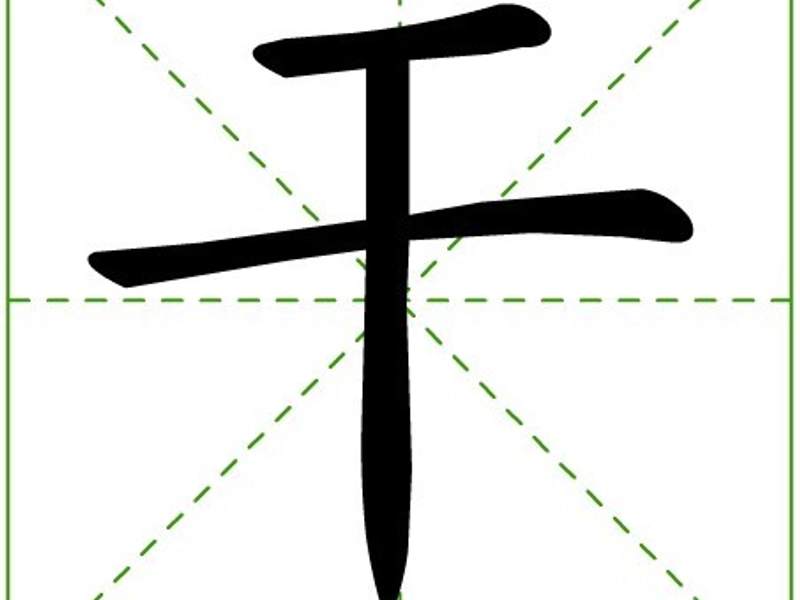
Simplified: 干
Pinyin: gàn (main meaning), gān (dry), also a component in other characters
Meaning: to do / work / shield / trunk / dry
The Chinese character "干" (gàn/gān) is a highly versatile and foundational character in Chinese. Its meanings span from concrete objects like a "shield" and "trunk" to abstract concepts of "doing" and "drying." Understanding this character and its numerous compounds is essential for grasping a wide range of vocabulary related to action, structure, and state.
Basic Meaning of "干"
The character "干" originally depicted a primitive weapon or a shield, a fork-shaped tool used for defense. This ancient meaning is still preserved in some classical texts and compound words. Over time, its meanings expanded significantly:
- As a noun (gàn), it came to mean the main "trunk" of a tree or the essential "main part" of something.
- As a verb (gàn), it evolved to mean "to do," "to work," or "to act."
- As an adjective (gān), it means "dry" or "dried up," and by extension, "empty" or "in vain."
This character's simplicity belies its complexity, as its pronunciation and meaning are entirely context-dependent.
Common Combinations with "干"
With "gàn":
- 干活 (gàn huó, to work): Refers to the act of doing labor or a job.
- 干部 (gàn bù, cadre/official): Refers to a functionary or leading personnel in an organization.
- 干什么 (gàn shén me, to do what): The common way to ask "What are you doing?" or "Why?"
- 干劲 (gàn jìn, drive/enthusiasm): Denotes the vigor and motivation to work.
- 树干 (shù gàn, tree trunk): The main stem of a tree.
With "gān":
- 干净 (gān jìng, clean): Combines "dry" and "quiet" to mean clean and tidy.
- 干燥 (gān zào, arid/dry): Describes a lack of moisture.
- 干杯 (gān bēi, Cheers!/Bottoms up!): Literally "dry cup," meaning to drink the entire glass.
- 干扰 (gān rǎo, to interfere/disturb): To cause an interruption.
- 葡萄干 (pú táo gān, raisin): Dried grape.
These combinations show how 干 forms the core of words related to action, structure, and physical state.
Extended Meanings of "干"
Beyond its literal meanings, 干 has several extended uses:
- Action and Agency: Represents the concept of taking initiative and accomplishing tasks.
- Essence and Framework: Symbolizes the core structure or main part of an organization or object (e.g., 骨干, gǔ gàn, "backbone/core member").
- State of Being: As "gān," it describes a physical state of dryness, which can be metaphorically extended to emotions (e.g., feeling drained).
- Kinship (in a broad sense): Appears in the term 干亲 (gān qīn), meaning "sworn" or "nominal" family relationships, like 干妈 (gān mā, godmother).
Cultural and Symbolic Significance
In Chinese culture, "干" carries significant practical and symbolic weight:
- Value of Action: The spirit of "干" (to do) is central to the modern Chinese ethos, emphasizing hard work, pragmatism, and getting things done. Slogans like "实干兴邦" (shí gàn xīng bāng, "Real work revitalizes the nation") underscore this.
- Structural Metaphor: The concept of "骨干" (backbone/core member) is a powerful metaphor for the essential, supporting members of any team or organization, reflecting a collectivist value.
- Social Connection: The ritual of "干杯" (bottoms up) in social dining is a crucial practice for building and reinforcing relationships (关系, guānxi).
- Historical Echo: Its original meaning as a "shield" connects it to ancient Chinese warfare and symbolism of protection.
Example Sentences
With "gàn":
- 他正在办公室里干活。
(He is working in the office.) - 你周末打算干什么?
(What do you plan to do on the weekend?) - 他是我们公司的骨干。
(He is a core member of our company.)
With "gān":
- 她把房间打扫得很干净。
(She cleaned the room until it was spotless.) - 北京的冬天非常干燥。
(The winter in Beijing is very dry.) - 来,为我们合作成功干杯!
(Come, let's toast to our successful cooperation!)
Related Vocabulary
| 中文 | Pinyin | English |
|---|---|---|
| 干 | gàn / gān | to do / dry / trunk |
| 干活 | gàn huó | to work |
| 干部 | gàn bù | cadre / official |
| 干什么 | gàn shén me | to do what? |
| 干净 | gān jìng | clean |
| 干燥 | gān zào | dry / arid |
| 干杯 | gān bēi | Cheers! / Bottoms up! |
| 骨干 | gǔ gàn | backbone / core member |
FAQ: Common Questions About the Chinese Character "干"
Q1: How do I know when to read "干" as "gàn" or "gān"?
A: It depends entirely on the word it's in. You must memorize the pronunciation of each compound. Generally, if it's about doing or the main part, it's gàn (干活, 骨干). If it's about dryness or interference, it's gān (干净, 干扰). "干什么" is a key phrase where it is always gàn.
Q2: Is the "干" in "干净" (clean) related to "dry"?
A: Yes, etymologically. Something that is "dry" is often perceived as "clean," as opposed to something wet, sticky, or muddy. The character 净 (jìng) adds the meaning of "pure" or "neat."
Q3: Can "干" be used as a standalone verb?
A: Yes, particularly as gàn. For example, "快干!" (Kuài gàn!) means "Hurry up and do it!" or "Get to work!" As gān, it's less common alone but can be used, like "衣服干了" (Yīfu gān le, "The clothes are dry").
Q4: How can learners remember the different meanings of "干"?
A: Create mental associations:
- gàn (to do): Think of someone saying "Let's get it done!" (sounds a bit like "gàn").
- gān (dry): Think of a gun left out in the sun, getting all dry and rusty.
- Trunk/Shield: Remember the original meaning—a shield is like a "trunk" you hold in front of you for protection.