
Why Do Chinese Sentences Often End with '了' (Le)? Decoding the Ultimate Mystery for Learners
Inhaltsverzeichnis
- Introduction: The Beloved and Hated'了'
- Core Concept Distinction: Actually, You Have Two'了's
- Deep Dive: Why Must Sentences End with'了'?
- Häufige Missverständnisse und Gegenbeispiele: Vermeidung der Fallstricke
- Praktische Ratschläge für Lernende: Wie man die Intuition meistert
- Fazit: Fließendes Chinesisch annehmen
- FAQ
Introduction: The Beloved and Hated'了'
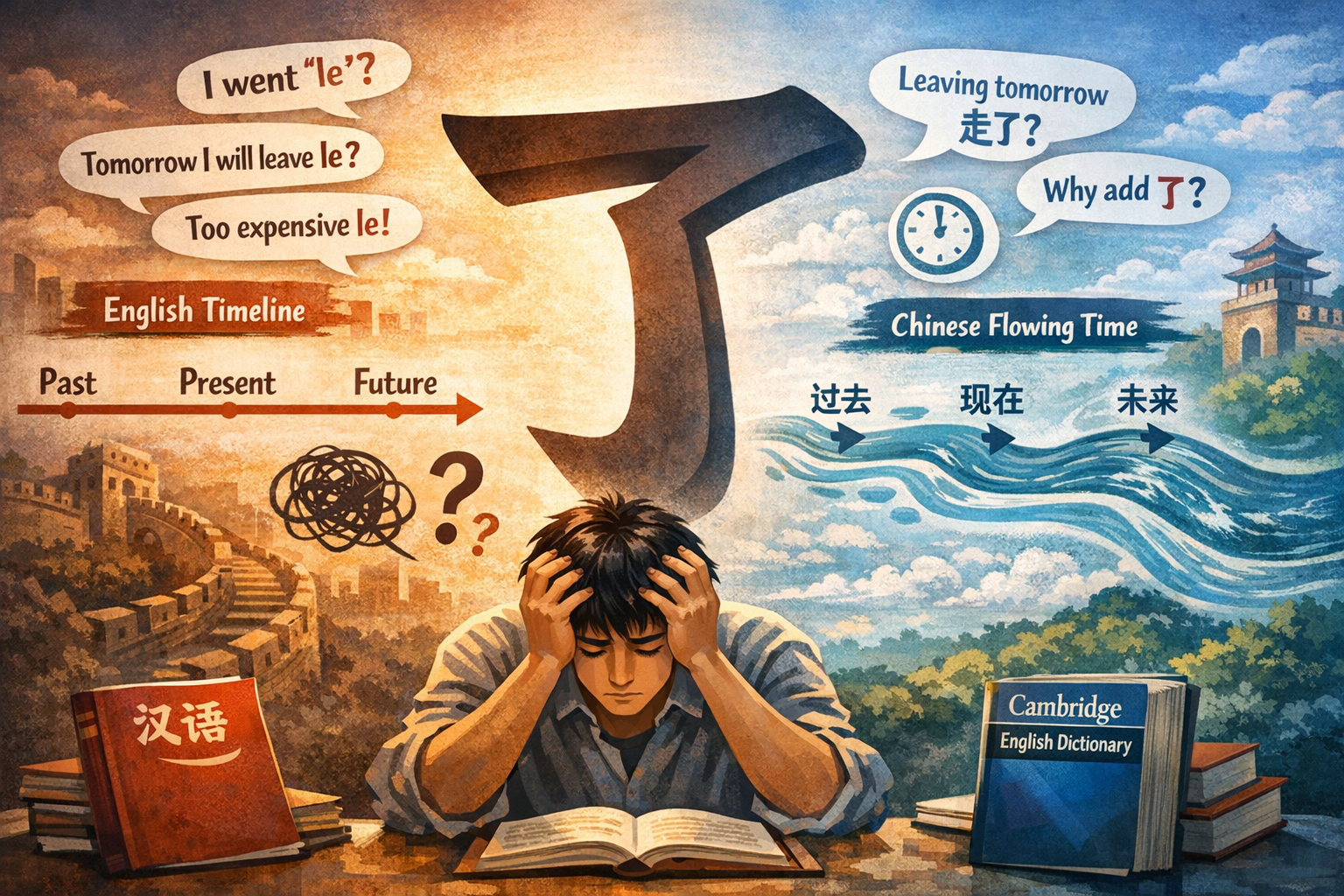
For any foreigner learning Chinese, the character'了' (le) is undoubtedly a formidable mountain to climb, or even a'nightmare.'In beginner classes, teachers often explain that'了'indicates the past tense, equivalent to the'-ed'suffix in English verbs. Delighted by this simple rule, learners might mistakenly try to construct sentences like'Yesterday I went le to the park.'While the intention is correct, the execution reveals a deeper complexity.
However, as proficiency grows, confusion mounts. When you want to say you are leaving tomorrow, the teacher says:'明天我就走了 (Tomorrow I will be leaving).'Wait, tomorrow hasn't happened yet. Why use a marker often associated with the past? When you exclaim that something is expensive, you hear:'太贵了!(Too expensive!)'No action took place here, so why add it? Even more frustrating is that sometimes, even when an action is clearly completed, you cannot add'了'; yet other times, when describing a current state, the sentence must end with this very particle.
The root of this confusion lies in our attempt to force the'Tense'logic of Indo-European languages onto the'Aspect'logic of Chinese. In English thinking, time is a straight line, and actions must be pinned to a specific point in the past, present, or future. In Chinese thinking, time is more like a flowing state; we focus not on when an action occurred, but on whether the action is complete and whether the situation has changed.
This article will deeply analyze why Chinese sentences so frequently end with'了', unveiling the cognitive logic behind this grammatical point to help learners shift from'rote memorization'to'intuitive understanding.'
Core Concept Distinction: Actually, You Have Two'了's
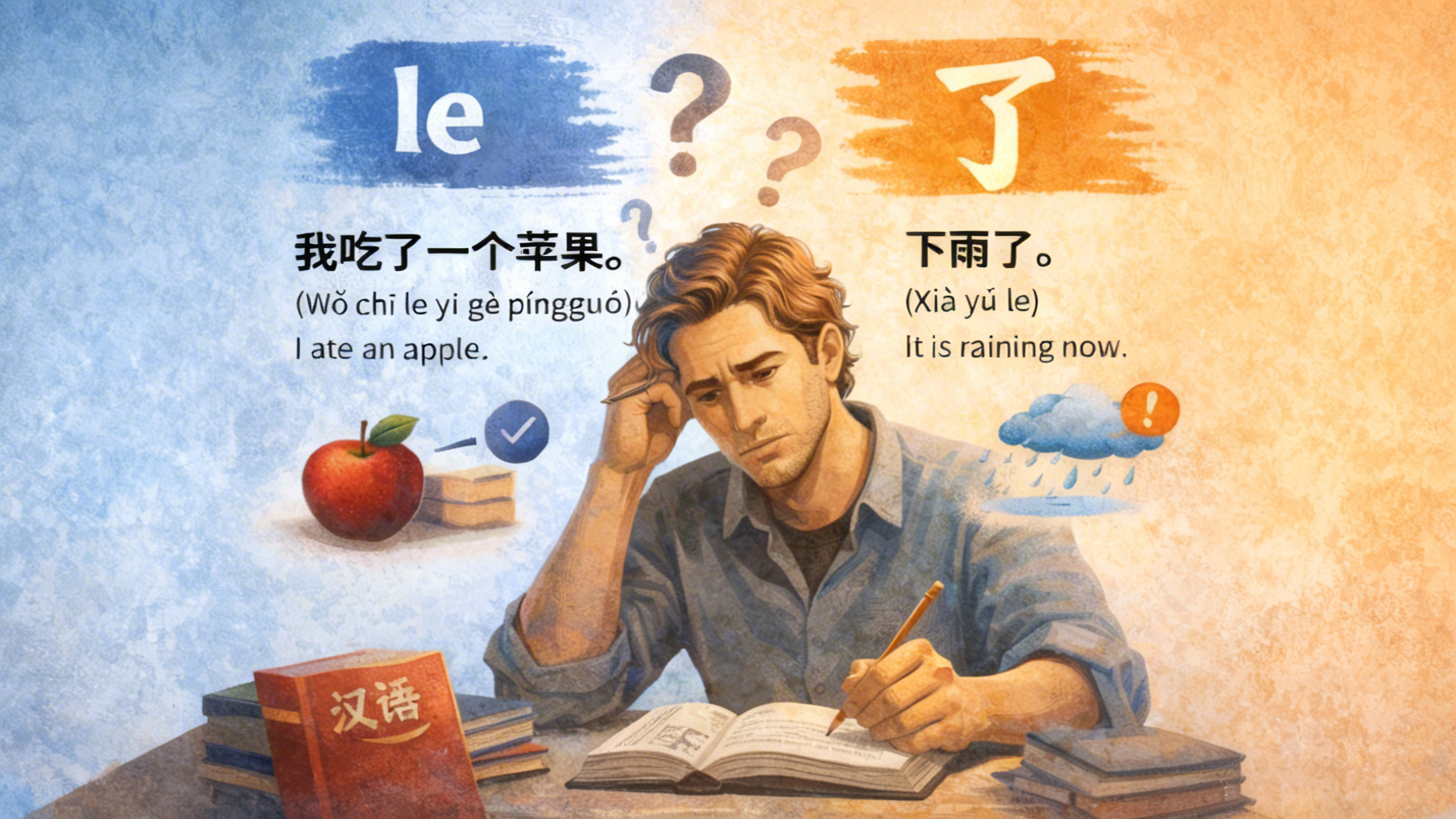
Um das Rätsel zu lösen, müssen wir zuerst eine oft übersehene Tatsache anerkennen: Es gibt tatsächlich zwei verschiedene'了's in Chinese. Although they share the same pronunciation and character, their functions are entirely different. Confusing these two is the starting point of all misunderstandings.
1. The'了'After the Verb (Le1): The Marker of Completion
The first'了', often referred to by linguists as'了₁'(Le1), is placed immediately after the verb and before the object.
- Struktur: Verb + 了 + Object
- Funktion: Es markiert den Abschluss einer Handlung. Stellen Sie es sich vor, als ob Sie einen Punkt am Ende einer Handlung setzen, der signalisiert, dass die Aufgabe erledigt ist.
- Beispiel:
Chinese: 我吃了一个苹果。 (Wǒ chī le yí gè píngguǒ.)
Englisch: 'I ate an apple.'
Hinweis: Here, 了 sits right after 'eat' to show the eating is finished. - Logik: Der Fokus liegt hier strikt auf der Tatsache, dass die Handlung des 'Essens' abgeschlossen ist. Diese Struktur sagt uns nicht unbedingt, ob ich jetzt satt bin oder wann genau dies geschah; sie betont einfach den Abschluss der Handlung selbst.
2. The'了'at the End of the Sentence (Le2): The Signal of Change
The second'了', the protagonist of this article, is'了₂'(Le2). It sits at the very end of the sentence.
- Struktur: Sentence + 了
- Funktion: Es markiert eine Zustandsänderung oder das Auftreten einer neuen Situation. Es ist der tonale Kern des Satzes, der dem Zuhörer sagt: 'Achtung! Die aktuelle Situation ist anders als zuvor!'
- Beispiel:
Chinese: 下雨了。 (Xià yǔ le.)
Englisch: 'It is raining now.' (Implikation: Es hat vorher nicht geregnet.) - Logik: Der Punkt dieses Satzes ist nicht, wann die Handlung des 'Regnens' begann, sondern dass er eine Information vermittelt: Der Zustand hat sich von 'kein Regen' zu 'Regen' geändert.
3. When the Two Meet: The Double'了'Structure
Manchmal muss ein Satz sowohl den Abschluss einer Handlung als auch eine Zustandsänderung ausdrücken. In solchen Fällen erscheinen beide Partikel.
- Struktur: Verb + 了₁ + Object + 了₂
- Beispiel:
Chinese: 我吃了饭了。 (Wǒ chī le fàn le.)
Englisch: 'I have eaten (and thus I am full/done).' - Aufschlüsselung:
- The first 了:The action of eating is complete.
- The second 了:My state has changed (e.g., I am no longer hungry, or I am free to do something else).
- Nuance: If one simply omits the first 了 in colloquial speech (e.g., 我吃饭了), the meaning of completion is often implied by default. However, using both places stronger emphasis on how the'completion'affects the'current state.'
Understanding this distinction is the first step toward correctly interpreting the sentence-final particle: The'了'at the end of the sentence is not just about time; it is about'change.'
Deep Dive: Why Must Sentences End with'了'?
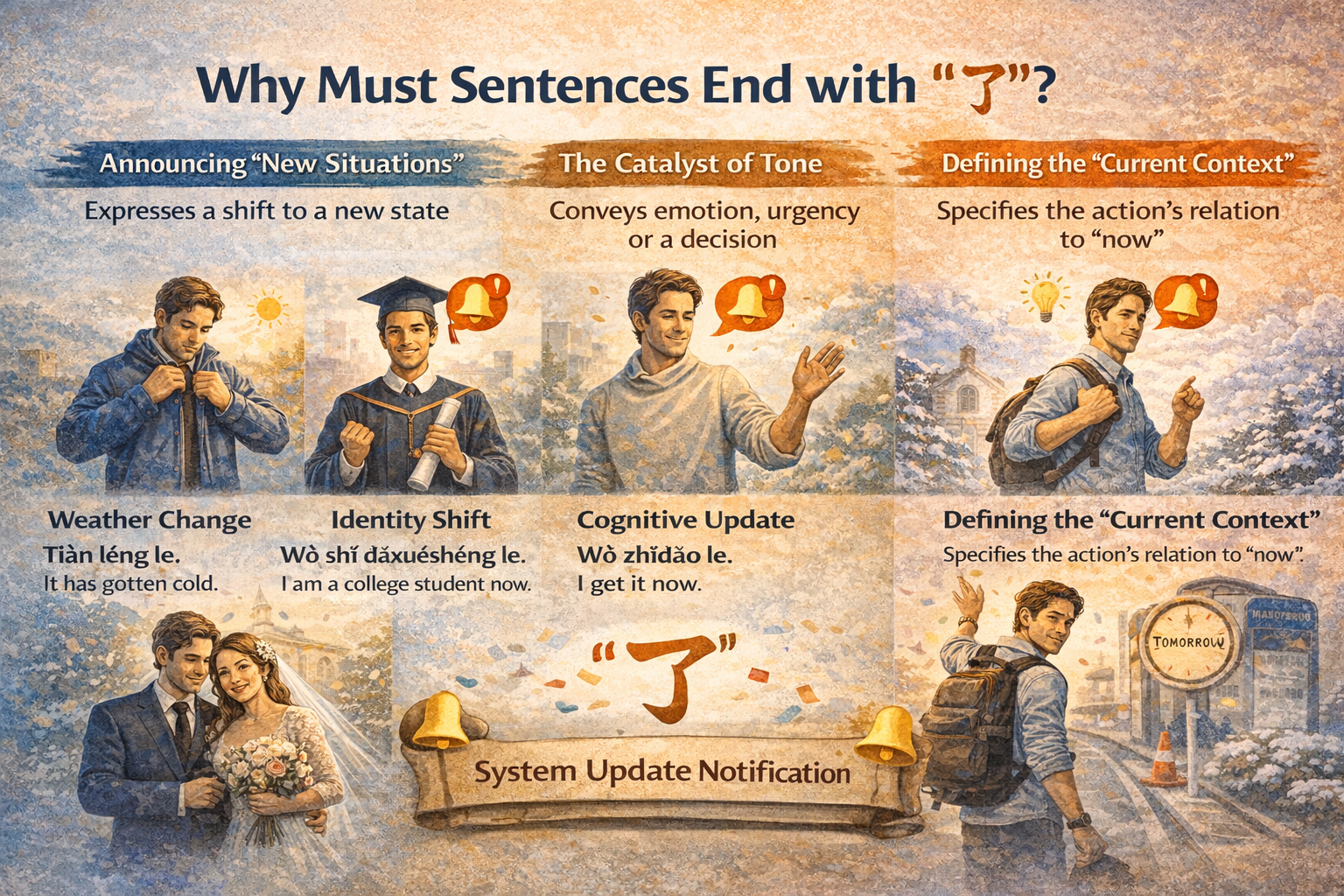
If the sentence-final'了'represents change, why does it appear so frequently in Chinese? This reflects the unique cognitive style and pragmatic habits of Chinese speakers.
1. A Dynamic Worldview: Announcing'New Situations'
Chinesische Sprecher neigen dazu, die Welt als einen ständig fließenden, sich verändernden Prozess zu betrachten. Wenn sie sprechen, berichten sie oft über einen neuen Zustand im Vergleich zu einem früheren Moment gegenüber ihrem Gesprächspartner.
Stellen Sie sich diese Szenarien vor:
- Wetteränderung: Früher war es warm, jetzt ist es kalt.
Chinese: 天冷了。 (Tiān lěng le.)
Bedeutung: 'It has gotten cold.' (Ohne 了 klingt 天冷 wie eine statische geografische Tatsache, z.B. 'In der Antarktis ist es kalt', und nicht wie ein Bericht über die aktuelle Wetteränderung.) - Identitätswechsel: Sie waren gestern Student, aber heute haben Sie Ihren Abschluss gemacht.
Chinese: 我是大学生了。 (Wǒ shì dàxuéshēng le.)
Bedeutung: 'I am a college student now.' (Betonung des Sprungs von 'Nicht-Student' zu 'Student'.) - Kognitive Aktualisierung: Sie wussten etwas vorher nicht, aber jetzt hat es Ihnen jemand gesagt.
Chinese: 我知道了。 (Wǒ zhīdào le.)
Bedeutung: 'I get it now.' (Ihr Gehirnzustand wechselte von 'unbekannt' zu 'bekannt'.)
Im Englischen können diese Bedeutungen durch Zeitformen (Present Perfect, Present Continuous) oder Kontext impliziert werden. Im Chinesischen jedoch verliert der Satz ohne diese Partikel seine Seele des 'dynamischen Aktualisierens' und wird statisch und steif. Die satzfinale Partikel '了' ist im Wesentlichen die'Systemaktualisierungsmeldung'der chinesischen Sprache.
2. The Catalyst of Tone: Emotion and Decision
Über die Angabe objektiver Zustandsänderungen hinaus erfüllt die satzfinale Partikel auch reichhaltige subjektive tonale Funktionen. Sie lässt den Satz wie eine echte Interaktion klingen und nicht wie eine kalte Aussage.
- Dringlichkeit und Entscheidung:
Chinese: 走了! (Zǒu le!)
Englisch: 'Let's go!' / 'Time to go!'
Analyse: The action of'going'isn't necessarily completed yet. However, adding 了 conveys a sense of'the time has come, no more hesitation.'If one just says 走,it sounds like a bare command lacking situational context. - Ausruf und Übertreibung:
Chinese: 太漂亮了! (Tài piàoliang le!) — 'So beautiful!'
Chinese: 饿死了! (È sǐ le!) — 'I'm starving!'
Analyse: In diesen Ausrufesätzen verstärkt die Partikel den Ton und zeigt an, dass ein Grad eine neue Spitze erreicht hat, was eine starke emotionale Reaktion auslöst. - Erinnerung und Warnung:
Chinese: 小心了! (Xiǎoxīn le!)
Englisch: 'Watch out!'
Analyse: Dies impliziert, dass eine gefährliche Situation gerade aufgetreten ist oder sich verschlimmern wird.
Wie man sieht, füllt die satzfinale Partikel die Sprache mit 'menschlicher Note' und einem Gefühl von 'Präsenz'. Sie verbindet den gemeinsamen unmittelbaren Kontext von Sprecher und Zuhörer.
3. Compensating for the Lack of Tense: Defining the'Current Context'
Chinesische Verben selbst ändern ihre Form nicht (go, went und gone werden alle durch dasselbe Zeichen 去 ausgedrückt). Wie vermitteln Sprecher dem Zuhörer also die Beziehung zwischen der Handlung und 'jetzt'? Die satzfinale Partikel '了' dient als entscheidender Anker.
Wenn Sprecher diese Partikel am Ende eines Satzes hinzufügen, ziehen sie effektiv eine zeitliche Grenze: Ab diesem Punkt sind die Dinge signifikant anders als zuvor.
- Chinesisch: 他结婚了。 (Tā jiéhūn le.)
Englisch: 'He got married.' / 'He is married now.'
Bedeutung: Vorher war er Single, nachher ist er verheiratet. Die Partikel trennt klar zwischen Vergangenheit und Gegenwart, ohne zusätzliche Zeitadverbiale zu benötigen. - Chinesisch: 我要走了。 (Wǒ yào zǒu le.)
Englisch: 'I am leaving now.'
Bedeutung: Vorher bin ich geblieben, nachher werde ich gehen. Sogar für zukünftige Ereignisse, solange der Sprecher eine 'bevorstehende Zustandsänderung' betont, kann die Partikel verwendet werden.
This is why'明天我就走了'(Tomorrow I will be leaving) is perfectly correct. Because looking from the perspective of the decision made now, 'leaving' is about to become the new reality tomorrow. Chinese focuses on the inevitability of change, not the absolute time point of the action.
Häufige Missverständnisse und Gegenbeispiele: Vermeidung der Fallstricke
Obwohl die 'Veränderungstheorie' die meisten Fälle erklärt, können Lernende dennoch in bestimmte Fallen tappen.
Misconception 1:'了'Equals Past Tense
This is the biggest misconception. As mentioned earlier, the particle can be used for the future.
- Falsches Verständnis: Automatically translating the presence of'了'as the English past tense suffix'-ed'.
- Richtige Interpretation:
- Past: 昨天他病了。 (Zuótiān tā bìng le.) — 'He got sick yesterday.' (State changed from healthy to sick).
- Present: 下雨了。 (Xià yǔ le.) — 'It is raining now.' (State changed from no rain to rain).
- Future: 明年我就三十岁了。 (Míngnián wǒ jiù sānshí suì le.) — 'Next year I will be thirty.' (State will change from twenty-nine to thirty).
- Bewertungskriterien: Don't ask'When is it?'Ask'Has it changed?'
Misconception 2: All Completed Actions Need'了'
Nicht jeder Satz, der eine abgeschlossene Handlung anzeigt, benötigt die Partikel, besonders in negativen Sätzen.
- Negative Sätze:
Incorrect: 我没吃了饭。 (Wǒ méi chī le fàn.)
Correct: 我没吃饭。 (Wǒ méi chī fàn.) — 'I didn't eat.'
Analyse: The negator 没 (méi) itself denies the occurrence of the action. Since the action didn't happen, there is no'completion'to mark, so 了 is omitted. - Ausnahme: If the negative indicates the disappearance of a state, 了 is used. E.g., 没钱了 (Méi qián le - 'I have run out of money'), marking the change from having money to having none.
- Aufzählung aufeinanderfolgender Handlungen:
Unnatural: 昨天我去了书店,买了书,然后回了家。 (Too many 了s make it choppy).
Natural: 昨天我去书店买书,然后回家。 ('Yesterday I went to the bookstore to buy books, and then returned home.')
Analyse: When narrating a series of past actions, Chinese relies on time words and word order. Too many particles make the sentence feel fragmented. Usually, 了 is only used at the very end to mark the conclusion of the whole event.
Misconception 3: Static Descriptions Must Add'了'
Wenn eine Tatsache konstant und unveränderlich ist, darf man die Partikel auf keinen Fall hinzufügen.
- Falsch: 他是老师了。 (Tā shì lǎoshī le.) — Wrong if he has been a teacher for ten years.
- Richtig: 他是老师。 (Tā shì lǎoshī.) — 'He is a teacher.'
- Analyse: You would only say 他是老师了 if:
- He just got the job (identity changed).
- Someone thought he wasn't, and you are correcting them.
Praktische Ratschläge für Lernende: Wie man die Intuition meistert
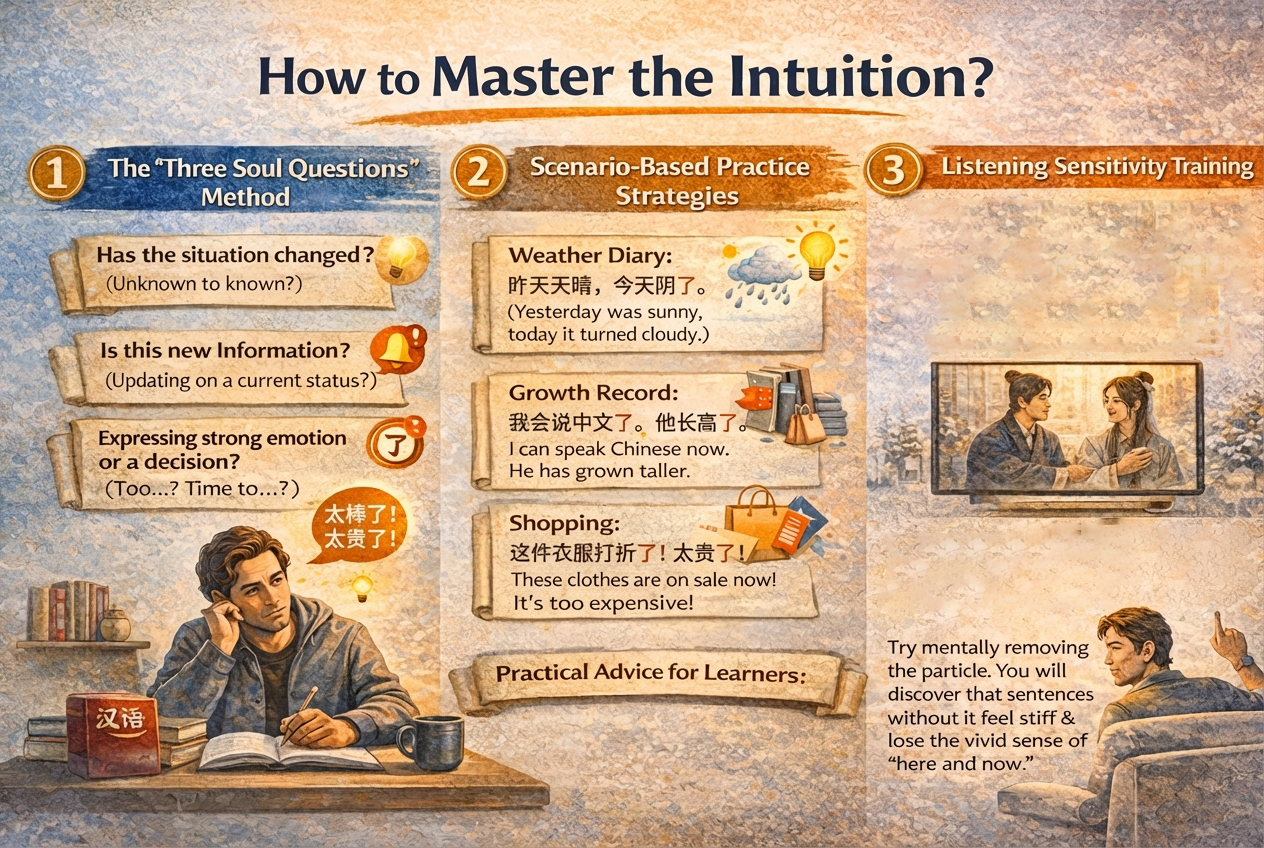
Das wahre Meistern der satzfinalen Partikel erfordert eine Veränderung der Denkmuster.
1. Die 'Drei-Seelen-Fragen'-Methode
Jedes Mal, wenn Sie die Partikel am Ende eines Satzes hinzufügen möchten, fragen Sie sich:
- Hat sich die Situation geändert? (Von unbekannt zu bekannt? Von nichts zu etwas?)
- Ist dies neue Informationen? (Aktualisiere ich den Zuhörer über einen aktuellen Status?)
- Drücke ich starke Emotionen oder eine Entscheidung aus? (Ist es 'zu...'? Ist es 'Zeit für...'?)
If the answer is yes, the sentence likely needs 了.
2. Szenarienbasierte Übungsstrategien
Üben Sie innerhalb spezifischer 'Veränderungsszenarien':
- Wettertagebuch: 昨天晴,今天阴了。 ('Yesterday was sunny, today it turned cloudy.')
- Wachstumsaufzeichnung: 我会说中文了。 ('I can speak Chinese now.') / 他长高了。 ('He has grown taller.')
- Einkaufen: 这件衣服打折了! ('These clothes are on sale now!') / 太贵了! ('It's too expensive!')
- Reisen: 车来了! ('The car is here!') / 走了走了! ('Let's go, let's go!')
3. Hörsensitivitätstraining
Wenn Sie chinesische Medien ansehen, achten Sie auf die Partikel am Ende von Sätzen.
- Notice the context when speakers say 太棒了 ('Awesome!'), 完了 ('It's over!'), or 好了 ('Okay/Done!'). Observe the turning point in the situation.
- Versuchen Sie, die Partikel gedanklich zu entfernen. Sie werden feststellen, dass Sätze ohne sie oft steif klingen, wie das Lesen einer Anleitung, und das lebendige Gefühl von 'hier und jetzt' verlieren.
Fazit: Fließendes Chinesisch annehmen

Warum enden chinesische Sätze oft mit dieser Partikel? Letztendlich, weil Chinesisch eine Sprache ist, die sich auf Veränderung konzentriert, die Gegenwart schätzt und voller dynamischer Vitalität ist.
Für ausländische Lernende, die an strenge Zeitensysteme gewöhnt sind, ist dieses Konzept eine Herausforderung. Es ist keine mathematische Formel; es ist eine Lebenskunst. Es erinnert uns daran, dass die Welt kein statischer Ausschnitt ist, sondern ein rauschender Fluss.
When you stop struggling with'Is this past or future?'and start perceiving'the difference between this moment and that moment,'when you can naturally blurt out'下雨了'(It's raining),'天黑了'(It's dark), or'我明白了'(I understand), you are no longer just using a grammar point. You are experiencing the world through the Chinese mindset.
That tiny particle'了'is no longer a stumbling block; it is a golden key. It marks your transition from'learning Chinese'to'living in Chinese.'Next time you want to express a new situation, a new feeling, or a new decision, confidently add that particle to the end of your sentence—because life updates every single moment, and your Chinese should be just as vibrant.
FAQ
If'了'indicates a change of state, can I use it with adjectives that don't seem to imply an action?
Yes, absolutely. In Chinese, adjectives often function as stative verbs. When you add'了'to an adjective (e.g., 大了 - dà le, 'big now'), it signifies that the degree of that quality has changed compared to before. For example, saying'孩子大了'(The child is big now) doesn't just describe their size; it implies they have grown from being small to being big. It marks the transition. If you simply say'孩子大', it sounds incomplete or like you are comparing two specific children rather than describing a change over time.
Why do we sometimes omit'了'even when talking about something that happened yesterday?
This usually happens in narratives or when the focus is on the sequence of events rather than the completion of individual steps. As mentioned in the article, if you list a series of actions (e.g., 'I woke up, brushed my teeth, and left'), adding'了'after every verb makes the sentence sound choppy and overly emphasized. Native speakers often rely on time words (like '昨天' - yesterday) and the logical order of verbs to show these things happened in the past. The final'了'might appear at the very end of the story to mark the conclusion of the whole event, but intermediate'了's are often dropped for flow.
Can I use'了'in a sentence that starts with'因为...所以...' (Because... therefore...)?
Generally, you should be careful. The particle'了'focuses on a new situation or a change. If the 'Because' clause explains a general fact or a permanent state, do not use'了'. For instance,'因为下雨了,所以地湿了'is correct because both the rain starting and the ground becoming wet are changes that just occurred. However, if you are stating a general logical truth (e.g., 'Because water is wet, clothes get wet'), no'了'is needed. You only use it in these structures if both the cause and the result represent a specific change relevant to the current moment.
What is the difference between'没...了'(méi...le) and just'没'(méi)?
This is a crucial distinction regarding the disappearance of something.'没'(Méi) alone simply negates an action or existence (e.g.,'我没钱'- 'I don't have money' as a general state). In contrast,'没...了'(Méi...le) specifically highlights the change from having to not having. It means 'run out of.' For example,'没钱了'(Méi qián le) means 'I used to have money, but now I have run out.' It emphasizes the loss or the transition to a state of emptiness, fitting perfectly with the core theme:'了'equals change.
Is the sentence-final'了'(Le2) ever used to express regret or realization?
Yes, this is an advanced tonal usage related to 'Cognitive Update.' When a speaker realizes something too late or understands a consequence,'了'adds a tone of finality or emotional weight to that realization. For example,'完了!'(Wán le!) literally means 'Finished,' but pragmatically it means 'It's over!' or 'We're doomed!' expressing sudden despair. Similarly,'我错了。'(Wǒ cuò le.) means 'I was wrong' (admitting a change in stance/realization). Without'了'('我错'), it sounds unnatural and incomplete. Here,'了'signals the shift from 'thinking I was right' to 'accepting I am wrong.'